Human orientation
Average score: The breed is attached to the family, but independent and passionate about the trail. Actual behavior depends on socialization.
THE PAW CATALOG
Origin: Great Britain
Bassets are descended from the French Saint Hubert Hound. Their short paws were suitable for tracking rabbits in thick thickets, and the first connoisseurs were French aristocrats. English breeders at the end of the 19th century fixed the modern type, and then the breed came to the United States.
The basset hound is a short, stocky hound that follows the scent slowly and confidently. Good-natured, patient and sociable, but stubborn and loud. Requires weight control, ear cleaning and secure enclosure or leash.

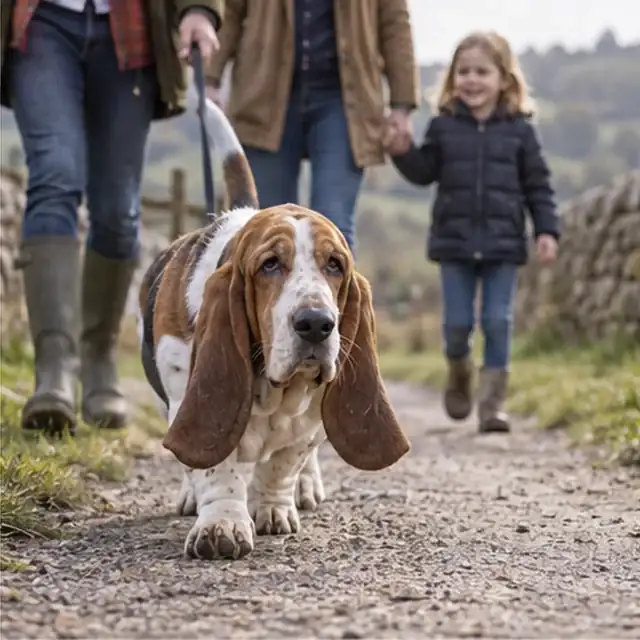
Suitable for people who like leisurely walks. The basset hound is less energetic than other hounds, but its sense of smell leads it on the trail, so it cannot walk freely outside the fence. He is not a watchman, howls loudly, and long loneliness causes anxiety.
Two or three 20-minute walks and daily play are enough for a healthy adult dog. A basset hound can walk a few kilometers at a leisurely pace, but it is unsuitable for long-distance running. The load of puppies and elderly dogs is adjusted with the veterinarian. Stairs and jumps are limited to protect the back.
Good-natured, but stubbornly follows the smell, so training and habituation to the toilet are slow. Patience, olfactory games and valuable treats work. Classes should be short and varied, and the call should be practiced on a long leash.
Short, smooth wool is combed daily or several times a week, because it is noticeably lazy. Long ears are cleaned weekly and checked for odor and redness. They bathe every one or two weeks, trim their claws. Drooling is normal.
Usually gentle and patient with children. The long back is vulnerable, so the child is taught not to lift the dog by its front legs and not to sit on it. Contact takes place under the supervision of an adult.
His pack origin makes him dog friendly. Cats are introduced gradually: the hunting instinct can work on the fast movements of small animals.
Estimates help compare breeds. For zooaggression, 5/5 means less tendency to aggression towards dogs. The behavior and health of a particular dog depend on many factors.
Average score: The breed is attached to the family, but independent and passionate about the trail. Actual behavior depends on socialization.
Average score: training requires a clear regime and patience, because the basset hound is stubborn and easily distracted by smells.
High Score: The breed usually gets along well with other dogs due to its pack history. The attitude towards small animals is assessed separately.
In the British cohort, the median lifespan of the breed was 12.5 years. Among the described breed risks: hip and elbow dysplasia, thyroid disorders, dislocation of the patella, glaucoma. The examination of the parents is confirmed with the veterinarian.
Below average: coat is noticeably lazy, ears and folds need regular attention, and drooling requires constant cleaning.
Hip dysplasia is mentioned as a possible risk. The results of the hip assessment of the parents should be asked from the breeder, and the need for examinations is determined by the veterinarian.
Elbow dysplasia is another joint problem that can cause lameness at a young age. Diagnosis and treatment are prescribed by a veterinarian.
Dysfunction of the thyroid gland (hypothyroidism) is mentioned as a possible risk. Symptoms: weight gain, lethargy, dry skin. The check is carried out by a blood test.
Dislocated patella: periodic limping or "jumping" on the hind leg. Diagnosis and treatment, sometimes surgical, is prescribed by a veterinarian. The basset hound's long back is also prone to intervertebral disc problems.
Glaucoma is mentioned as a possible risk. Signs: red eyes, pupil changes size, dog squints. This is an emergency, so see your vet right away. Among the other conditions described is gastric reflux.