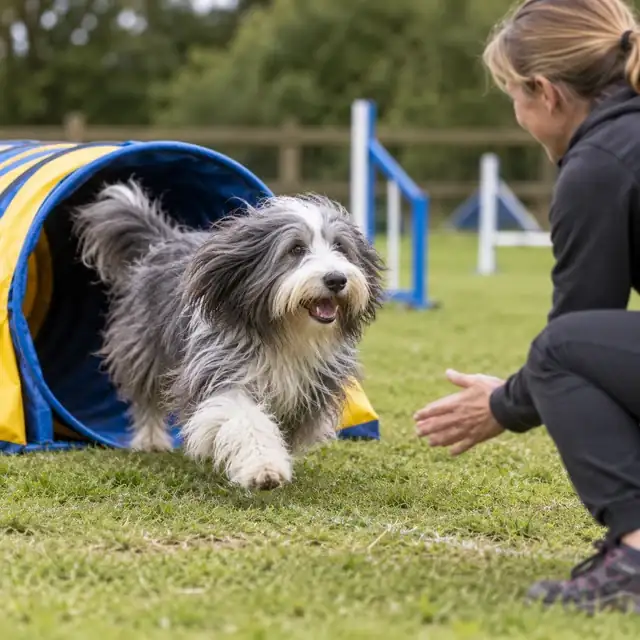
Human orientation
High score: Bearded collies are usually willing to interact with their family. Actual behavior depends on socialization.
THE PAW CATALOG
Origin: Great Britain
The breed comes from the Scottish Highlands, where sheep grazed. Then the dogs moved to homes, in the middle of the 20th century they got to the USA, and the AKC recognized the breed in 1983.
The Bearded Collie is a medium-sized herding dog with a long shaggy coat and beard. Cheerful, intelligent and independent, loves people and movement. Needs daily grooming, active walks and communication.

Suitable for active families who spend a lot of time with their dog. Without communication and activities, he gets bored, barks and "grazes" people and animals. Long hair takes time.
A healthy adult dog needs at least an hour of activity every day: walks, running, fetch, agility, shepherd games. Mental load is just as important. The load of puppies and elderly dogs is adjusted with the veterinarian.
Smart, but strong-willed. Positive reinforcement, various activities and early socialization work. The shepherd's instinct is directed to games and sports.
The double long coat is combed daily, and once a week more deeply, so that the swallows do not appear. They bathe every four to six weeks, examine their ears, and brush their teeth daily.
Usually joyfully plays with children, but energetic and can knock down a baby or "pick up" children by the bones. An adult monitors the contact.
Usually friendly to other dogs and lives peacefully with animals if socialized from an early age. The herding instinct can be manifested in relation to small animals.
Estimates help compare breeds. For zooaggression, 5/5 means less tendency to aggression towards dogs. The behavior and health of a particular dog depend on many factors.
High score: Bearded collies are usually willing to interact with their family. Actual behavior depends on socialization.
Average score: training requires a clear regime and patience, because the dog is strong-willed.
High score: the breed usually gets along well with other dogs. The attitude towards small animals is evaluated separately due to the shepherd's instinct.
In the British cohort, the median lifespan of the breed was 13.9 years. Among the described breed risks: hip dysplasia, thyroid disorders, allergic skin diseases, autoimmune diseases, eye diseases. The examination of the parents is confirmed with the veterinarian.
Low rating: Long double coat requires daily brushing and long maintenance.
Hip dysplasia is mentioned as a possible risk. The results of the hip assessment of the parents should be asked from the breeder, and the need for examinations is determined by the veterinarian.
Thyroid disorders are mentioned as a possible risk. Symptoms: weight gain, lethargy, dry skin. Diagnosis is carried out by a blood test.
Allergic skin diseases occur in breeds. Symptoms: itching, redness, licking paws. Diagnosis and treatment are prescribed by a veterinarian.
Autoimmune diseases are mentioned as a possible risk, including hypothyroidism and immune-mediated anemia. Ask the breeder about cases in the line.
Eye diseases, particularly cataracts and progressive retinal atrophy, are mentioned as possible risks. Eye examinations are included in routine examinations. Ear infections are also described.