Human orientation
High score: the breed usually willingly interacts with the owner. Actual behavior depends on socialization.
THE PAW CATALOG
Origin: Belgium
The breed originates from Belgium, where it was once called the Belgian Street Hangman. Presumably, the Affenpinscher was among the ancestors. A similar dog is depicted in a painting by Jan van Eyck in 1434, and in the 17th century the type was already established. Griffon lived in stables where horses were kept for cabs, and came to Britain at the end of the 19th century.
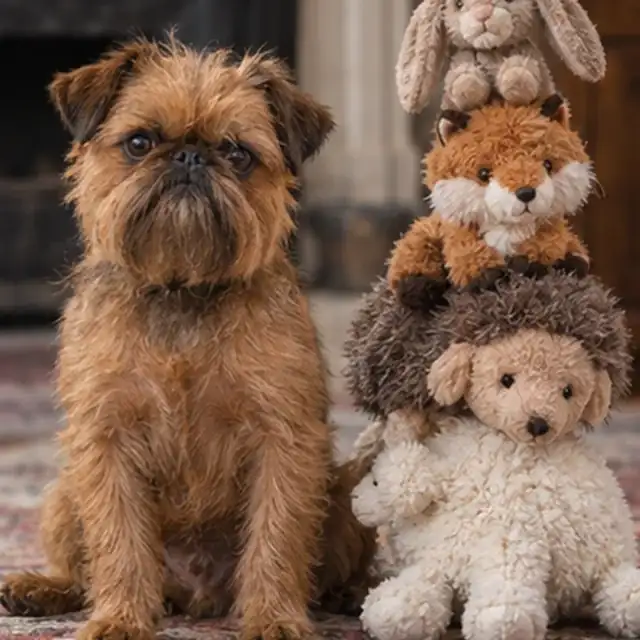
The Brussels Griffon is a small Belgian companion with a flat shaggy face and expressive eyes. Very attached to the owner, sensitive and smart. Requires heat protection, eye care, and respiratory and neurological monitoring.

Suitable for living in an apartment and for people who spend a lot of time at home. This is a "Velcro dog": very attached, does not tolerate loneliness well. He can be wary of strangers and barks at a knock on the door.
A healthy adult dog needs about 30 minutes of moderate activity every day: walks and games at home. The load of puppies and elderly dogs is adjusted with the veterinarian. The heat is dangerous.
Smart but sensitive. Short affectionate sessions with treats and early socialization work. Toilet training can be slow.
There are smooth-coated and hard-coated versions. Smooth coat is combed from daily to weekly, hard coat is weekly and trimmed once every 4-8 weeks. Wrinkles on the face are wiped and dried, eyes are examined, teeth are cleaned regularly.
Due to its small size, it is better suited to a family with older children who know how to handle the dog carefully. An adult monitors every contact.
Usually gets along with other dogs, but self-confident and does not feel his own size. Acquaintances with large dogs are carried out carefully.
Estimates help compare breeds. For zooaggression, 5/5 means less tendency to aggression towards dogs. The behavior and health of a particular dog depend on many factors.
High score: the breed usually willingly interacts with the owner. Actual behavior depends on socialization.
Brussels Griffon dogs respond well to consistent reward training; long boring classes and forced coercion do not work.
Average score: contact with other dogs requires assessment and caution due to size.
Low score: In a British cohort, the breed's median lifespan was 13.3 years. Among the described breed risks: hip dysplasia, cataracts. The examination of the parents is confirmed with the veterinarian.
Average rating: hard coat combed weekly and periodically trimmed, folds and eyes need attention.
Hip dysplasia is mentioned as a possible risk. The results of the parents' assessment should be asked from the breeder, and the need for examinations is determined by the veterinarian. Among the known problems of the breed are also dislocation of the patella and dental disease.
Cataracts are mentioned as a possible risk. The eyes of flat-faced breeds are also prone to injuries, so the eyes are examined regularly. Respiratory problems and syringomyelia are also described: obsessive itching and pain for no reason require a neurologist's examination.