Human orientation
Very high rating: friendly and kind, protects the family. Behavior depends on upbringing.
THE PAW CATALOG
Origin: Germany
Bred for wild boar hunting in Europe, Germany gave it its modern form. The breed is considered ancient: similar dogs are depicted on Egyptian monuments. German and English breeders set the standards in the 19th century, and at the first dog show in Germany in 1863, there were already Great Danes.
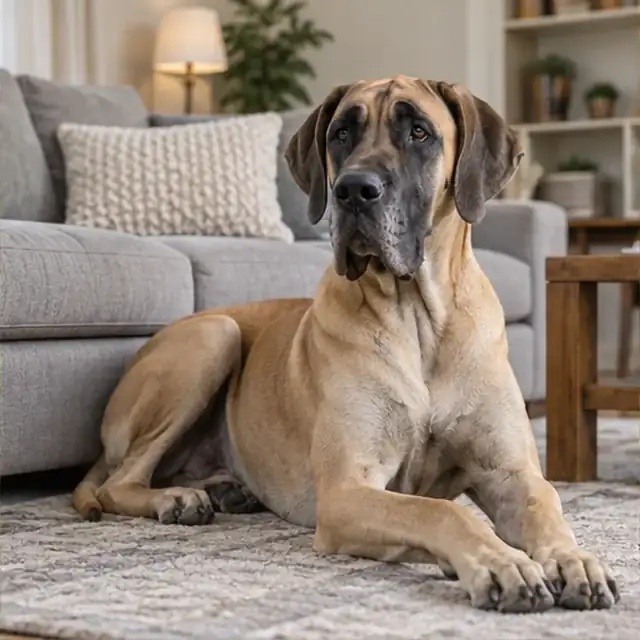
The Great Dane is a giant (from 71-76 cm and 46-54 kg) with short thick smooth fur of six recognized colors. Calm, kind, friendly and protective, but requires mandatory obedience due to size. Prone to stomach upset, heart and joint problems.

Suitable for a family with a spacious house. A calm domestic dog resting at home after a daily walk. A place to lie down and a reliable fenced yard are needed.
About 40 minutes of daily activity is enough: walking for half an hour or an hour. Puppies are not overloaded in growth.
Kind and willing to learn. Obedience is mandatory from a puppy age, because an adult Great Dane is too big to force it. Classes are soft, with praise.
Short hair is brushed once a week. Claws are trimmed, teeth are cleaned, ears are examined.
Kind and friendly, protects the family. Due to their size and strength, games with toddlers are supervised.
Generally friendly, gets along with other animals with early socialization.
Estimates help compare breeds. For zooaggression, 5/5 means less tendency to aggression towards dogs. The behavior and health of a particular dog depend on many factors.
Very high rating: friendly and kind, protects the family. Behavior depends on upbringing.
Average score: Willing to learn, but size requires mandatory obedience.
Average score: generally friendly, needs socialization.
In the British cohort, the median lifespan of the breed was 10.6 years. Among the described breed risks: dysplasia of the hip joints, thyroid gland dysfunction, bloating or stomach twist; examination of the parents is confirmed with the veterinarian.
High rating: short, smooth coat requires minimal maintenance.
Stomach expansion and torsion is a serious risk for Great Danes: painful distension and twisting of the stomach. They feed in small portions, avoid loads before and after meals, and immediately go to the veterinarian at the first signs.
Heart diseases are detected during routine examinations at the veterinarian. New fatigue, cough or shortness of breath require examination.
Hip dysplasia is hereditary, so puppies are taken from controlled breeding. The results of examinations of both parents are requested.
Dysfunction of the thyroid gland is manifested by weight gain, lethargy and changes in the skin. Diagnosed by a veterinarian based on tests.