Human orientation
Average score: the breed is attached to the family, but relies on its sense of smell and acts independently in its work. The behavior of a particular dog depends on socialization.
THE PAW CATALOG
Origin: France
The ancestors of the breed go back to the ancient great hounds of France. Packs of such dogs were kept as early as the 14th century at the court of Count de Foix, and at the end of the 16th - at the beginning of the 17th century - at the court of Henry IV. Gascon hounds used to hunt deer, wolf and wild boar, but now they are more often used to hunt hare. The breed took part in the creation of the Gascon Saint-Jean and the Bluetic Coonhound.
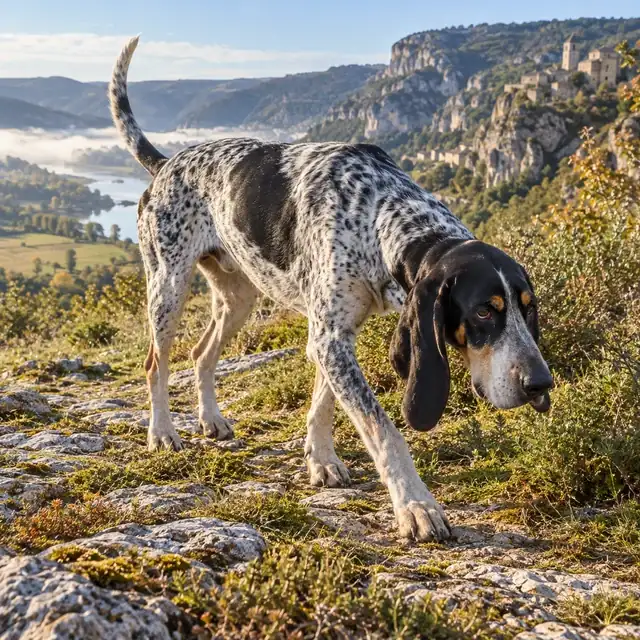
The Big Blue Gascon Hound is a full-bodied French Hound with a short, dense coat, white with black markings that looks slate blue. Red "eyebrows" are visible above the eyes. A low ringing voice and excellent sense make him a real hunter, not a couch dog. Needs space, long walks and a patient owner.

Not suitable for an apartment: the size, voice and need for movement require a house with a strong fence. A dog that has attacked a trail does not hear commands, so walking off-leash outside a safe area is risky. Loneliness does not tolerate well, as do most pack dogs.
Daily long walks on a leash and regular sniffing are a must. A healthy adult dog can withstand many hours of searching outings. Without movement, she gets bored, barks a lot and climbs over the fence.
Balanced, but stubborn, when the sense of smell is stronger than the command. Basic commands are managed with successive short sessions, and recall requires separate work from an early age. Olfactory games and finding tracks help channel natural energy.
It is enough to brush the short coat every week, more often during shedding. Long, hanging ears are inspected and cleaned after walks, because they retain moisture and dirt. Claws are trimmed as needed, and teeth are cleaned regularly.
The restrained, calm nature allows you to get along with children, but the large size and strength require supervision when playing with children. Children are taught not to pull their ears and not to disturb the dog while eating.
A pack hunter, so he usually gets along with other dogs. Small animals, cats and domestic rodents can cause the instinct of pursuit, so introductions are carried out gradually and under control.
Estimates help compare breeds. For zooaggression, 5/5 means less tendency to aggression towards dogs. The behavior and health of a particular dog depend on many factors.
Average score: the breed is attached to the family, but relies on its sense of smell and acts independently in its work. The behavior of a particular dog depends on socialization.
Average score: strong sense of smell and independence make listening difficult. Patience and short, consistent sessions are required.
Average rating: the hound usually gets along with dogs as a gregarious, and treats small animals with a hunting interest.
The British cohort does not provide a comparable survival estimate for the Great Blue Gascon breed. The absence of the mentioned risks does not prove the absence of hereditary diseases, and parents should be checked in any case.
Average rating: Short coat is easy, but the ears and condition of a large dog need attention.
Breed screening: there are few descriptions of hereditary diseases of the Big Blue Gascon Hound breed. Ask the breeder for the written results of the parents' examinations and the current requirements of the club.
Musculoskeletal system: the growth and load of the "Big Blue Gascon Hound" breed should be age-appropriate. Lameness, pain, or reluctance to move require a veterinary examination.
A preventive examination of the Great Blue Gascon Hound includes an evaluation of the eyes, heart and ears. The frequency of special inspections is determined by the recommendations of the club and the veterinarian.