Human orientation
Devoted to the family, with a pronounced protective instinct.
THE PAW CATALOG
Origin: Russia
Bred in Russia in the late 1940s and early 1950s by the Russian military on the basis of crossing many breeds. The Giant Schnauzer had the greatest influence. The goal was to create a large, strong and manageable service dog.
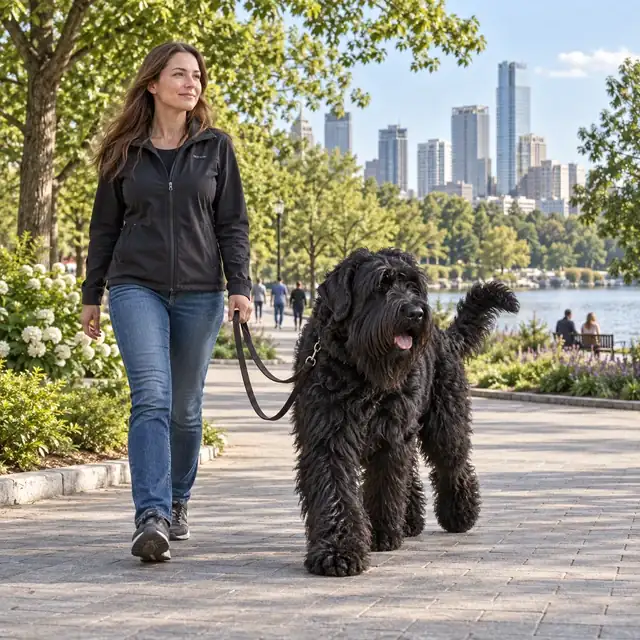
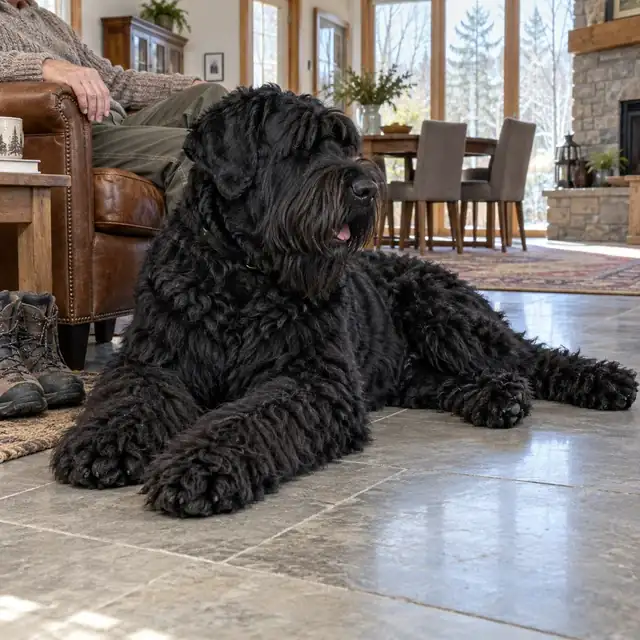
The Black Russian Terrier is a large (males 70-78 cm and 50-60 kg, bitches 66-74 cm and 45-50 kg) dignified, intelligent and self-confident dog with thick black fur. Built as a strong, manageable working and guard dog with a strong guarding instinct. Requires an experienced owner, early socialization and constant supervision in all situations.

Not recommended as a first dog. Previous experience with guard breeds is recommended. This is an indoor breed, unsuitable for life on a chain or in an aviary. Suitable for families with a large house, yard and time for classes.
Moderately high. Daily long walks, classes and work. A strong dog that needs mental and physical exercise.
Basic obedience and early socialization are a must. Teaching is consistent, calm, without rudeness. The protective instinct needs clear boundaries. Guests and strangers are introduced to the dog in a controlled manner.
The coat is coarse on the outside with a soft, thick undercoat approximately 4-10cm long. Brushed weekly to avoid matting, slicker, undercoat comb and trimming comb are useful. It sheds little, but long wool without combing forms a cluster. Haircut and trimming are required regularly.
Children and the dog are always under the supervision of an adult, because the size and strength are large. Children are taught to behave calmly. Stranger children are introduced to the dog carefully.
Early socialization with dogs and animals is required. A protective nature can be manifested in relation to other people's dogs. The walk is organized safely.
Estimates help compare breeds. For zooaggression, 5/5 means less tendency to aggression towards dogs. The behavior and health of a particular dog depend on many factors.
Devoted to the family, with a pronounced protective instinct.
Intelligent, but needs experienced guidance.
Early socialization is required, the protective instinct is strong.
In the British cohort, the median lifespan of the breed was 10.9 years; small sample: 71 deaths. Among the described breed risks: elbow joint dysplasia, progressive retinal atrophy, allergic skin diseases; examination of the parents is confirmed with the veterinarian.
Thick wool requires regular combing, trimming and cutting.
Dysplasia of the elbow joints: the results of examinations of both parents are requested. Excess weight increases the load on the joints, so the puppy should not be overfed. Lameness is shown to the veterinarian.
Progressive retinal atrophy: an inherited disease that gradually leads to blindness. Ask the breeder for the results of genetic tests and ophthalmological examinations of the parents.
Allergic skin diseases: itching, redness and baldness require a veterinary examination.